
Electrical Measurements and Measuring Instruments: A Clear Guide for Students and Technicians
Every electrical system, from a home wiring circuit to a large power plant, depends on accurate measurement. Without reliable readings of voltage, current and power, faults go unnoticed and equipment gets damaged. Understanding electrical measurements and measuring instruments helps students, technicians and engineers test, calibrate and maintain systems with confidence.
What Are Electrical Measurements?
Electrical measurement is the process of finding the value of an electrical quantity, such as voltage, current, resistance, power, energy or frequency, by comparing it with a known standard. Measuring instruments are the devices that make this comparison and display the result, either on a scale or on a digital screen.
Basic Quantities and Their Units
Every reading is expressed in a standard unit. The main quantities are:
- Voltage, measured in volts (V)
- Current, measured in amperes (A)
- Resistance, measured in ohms (Ω)
- Power, measured in watts (W)
- Energy, measured in kilowatt-hour (kWh)
- Frequency, measured in hertz (Hz)
Types of Measuring Instruments
Instruments are broadly grouped by how they work and what they display.
Analog Instruments
These use a pointer that moves over a calibrated scale. Moving coil, moving iron and dynamometer-type meters are common examples. They are valued for easy viewing of trends and simple construction.
Digital Instruments
These convert the measured signal into numbers shown on a display. They offer higher resolution, easy reading and fewer reading errors. Digital multimeters are widely used in labs and workshops.
Recording and Indicating Instruments
Indicating instruments show the value at that moment, while recording instruments such as oscilloscopes and data loggers store readings over time for later study.
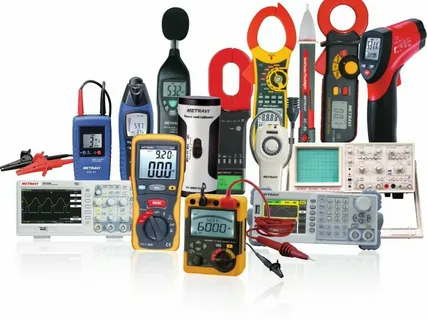
Commonly Used Instruments and Their Purpose
- Ammeter: measures current and is connected in series with the circuit
- Voltmeter: measures voltage and is connected in parallel across the component
- Ohmmeter: measures resistance of a de-energised circuit
- Wattmeter: measures real power in a circuit
- Energy meter: records the total electrical energy consumed
- Multimeter: combines voltage, current and resistance measurement in one device
- Oscilloscope: displays voltage waveforms against time
- Megger: checks insulation resistance of cables and machines
Understanding Accuracy, Precision and Errors
No instrument is perfect. Accuracy shows how close a reading is to the true value, while precision shows how consistently repeated readings agree. Errors may arise from the following:
- Instrument errors, caused by ageing, friction or poor calibration
- Environmental errors, caused by temperature, humidity or magnetic fields
- Observational errors, such as reading a scale from the wrong angle
- Loading errors, where the meter itself disturbs the circuit being tested
Regular calibration against a known standard keeps these errors within acceptable limits.
How to Select the Right Instrument
The right choice depends on the task. Check the measurement range, required accuracy, supply type (AC or DC), frequency range and the safety category of the meter. For high-voltage or industrial work, an instrument with proper insulation and a suitable safety rating is essential.
Safety Practices While Measuring
Always begin with the highest range when the value is unknown. Never connect an ammeter across a supply, and never measure resistance in a live circuit. Use insulated probes, inspect leads for damage and wear protective gear where required. Keeping the work area dry also reduces risk.
Conclusion: Measure Correctly, Work Safely
A sound grasp of electrical measurements and measuring instruments forms the base of all electrical testing and maintenance. Knowing which instrument suits which quantity, how errors arise and how to use each device safely leads to dependable readings and better decisions. With regular calibration and careful handling, these instruments remain trusted tools for every laboratory, workshop and industry.