
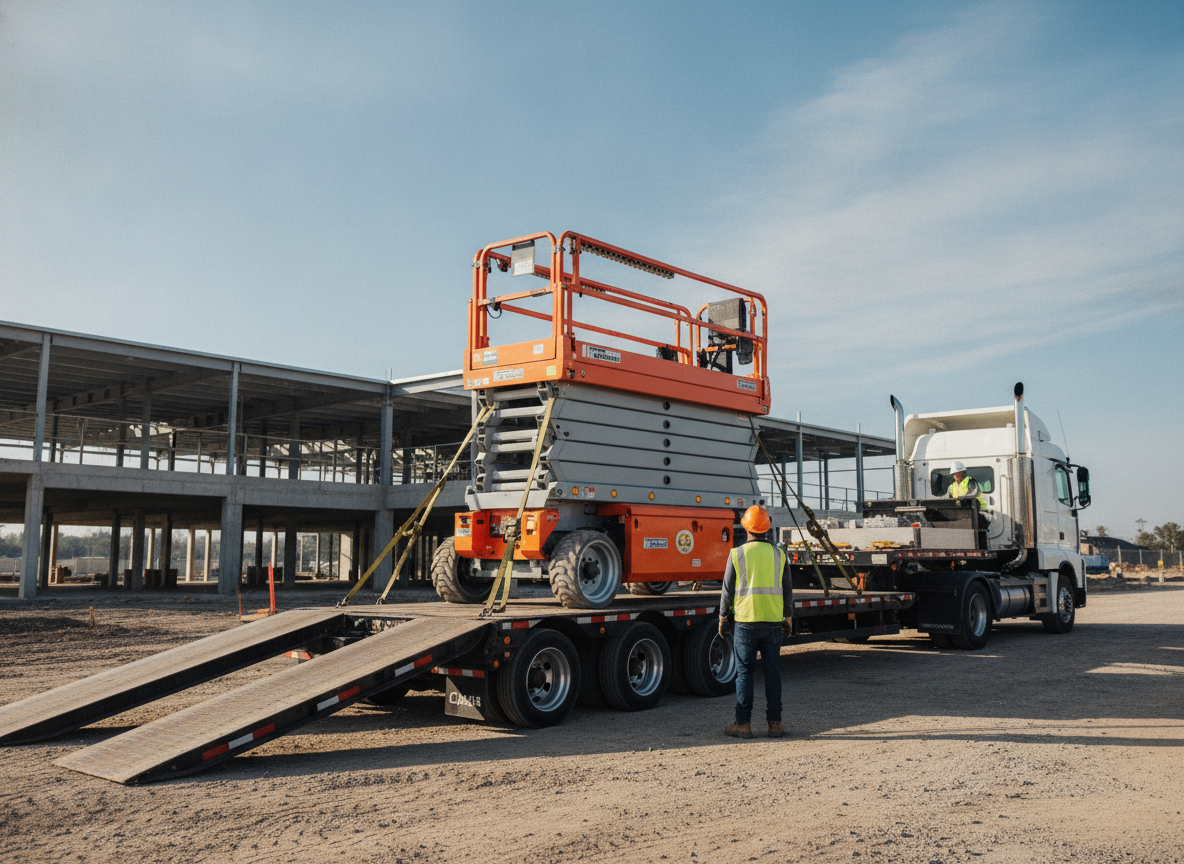
Access Equipment Delivery in Sydney: What to Expect and How to Plan Ahead
Whether it’s a scissor lift for an interior fitout, a boom lift for facade maintenance, or an elevated work platform heading to a construction site, When the right equipment arrives on site at the right moment, projects keep moving without interruption. Access equipment delivery in Sydney comes with its own set of logistical considerations — tight CBD streets, congested arterial roads, site access restrictions, and permit requirements that vary depending on what’s being delivered and where. Understanding how to plan around these factors is what separates a smooth delivery from an expensive delay.
Why Access Equipment Delivery Isn’t Just a Standard Drop-Off
Access equipment is purpose-built for working at height, which means it tends to be heavy, wide, and low to the ground. Scissor lifts, boom lifts, telehandlers, and elevated work platforms each have specific transport requirements — from the trailer type needed to the tie-down points used to secure the machine during transit. Delivering this equipment safely and without damage requires drivers and operators who understand the machinery, not just the road.
Sydney’s road network adds further complexity. Overhead powerline clearances, narrow laneways in older suburban areas, height restrictions at loading docks and car park entries, and the sheer density of traffic during business hours all affect how deliveries are planned and executed. A delivery that arrives late because the route wasn’t properly assessed isn’t just an inconvenience — on a time-sensitive project with crew waiting on site, it’s a direct cost.
Types of Access Equipment Commonly Delivered Across Sydney
The range of equipment that moves through Sydney’s construction, maintenance, and events sectors is broad. Regularly delivered access equipment includes:
- Scissor lifts — electric and diesel, for indoor fitouts, warehousing, and outdoor maintenance work
- Boom lifts — straight and articulating, for reaching height and working around obstacles
- Elevated work platforms (EWPs) — truck-mounted and trailer-mounted units for utility and infrastructure work
- Spider lifts — compact and versatile for confined or sensitive access situations
- Telehandlers — for materials handling on construction sites requiring elevated reach
- Vertical personnel lifts — for narrow aisle warehousing and low-height access tasks
- Rough terrain lifts — for construction sites where ground conditions rule out standard wheeled equipment
Each machine has different dimensions, weights, and ground pressure considerations that affect how it’s transported and what site conditions are needed to receive it safely.
Planning the Delivery: Key Factors That Make a Difference
A well-planned access equipment delivery in Sydney starts well before the truck leaves the depot. The following factors need to be confirmed before scheduling a delivery:
Site access and ground conditions — can the delivery vehicle reach the unloading point? Overhead clearances, gate widths, kerb heights, and the load-bearing capacity of the ground at the unloading location all affect whether the machine can be driven or lifted off at the intended spot. Soft ground, slopes, or underground services beneath the delivery area can create problems that are much easier to manage when identified in advance.
Delivery timing — access equipment deliveries in the Sydney CBD and inner suburbs are often subject to local council restrictions on truck movements, particularly during morning and afternoon peak periods. Some sites require deliveries outside standard hours — early morning, weekend, or overnight — to avoid disrupting surrounding businesses or traffic. Confirming these requirements upfront avoids the cost of a truck being turned away at the gate.
Permit and traffic management requirements — for deliveries involving road occupancy, lane closures, or parking of delivery vehicles on public roads, permits from Transport for NSW or the relevant local council may be required. On busy Sydney streets where there’s no practical off-road delivery option, arranging these permits before the delivery date is essential.
Equipment dimensions on the transport — knowing the transport height and width of the machine in its travel configuration, not just its working dimensions, determines whether the chosen route has adequate clearances for the delivery vehicle and its load.
What a Reliable Delivery Provider Handles for You
A quality access equipment delivery provider doesn’t just move the machine from A to B. The value they add comes from the experience and systems they bring to the logistics around it. A reliable provider will:
- Conduct a route assessment for unusual or restricted deliveries before confirming a booking
- Advise on appropriate delivery windows for the specific site and location
- Handle permit applications where road occupancy or oversized load requirements apply
- Confirm site access requirements with the customer before the day of delivery
- Provide drivers experienced in operating access equipment during loading and unloading
- Document the condition of the machine at the time of delivery to protect all parties
The difference between a provider that manages all of this as standard practice and one that leaves the customer to work it out is significant, particularly on projects where any delay has downstream consequences.
Coordinating Deliveries on Active Construction Sites
Active construction sites in Sydney present a specific set of delivery challenges. Site inductions, traffic management plans, designated unloading zones, and site supervisor sign-off processes all need to be accounted for when scheduling access equipment delivery. On large sites with multiple contractors and deliveries arriving throughout the day, the window for each delivery may be tightly controlled and difficult to reschedule if missed.
Communicating the delivery details — including vehicle dimensions, driver contact information, and expected arrival time — to the site manager well in advance is a straightforward step that prevents a significant amount of avoidable friction on the day.
When the Weather Doesn’t Cooperate
Sydney’s weather can change quickly, and wet conditions affect both delivery vehicles and access equipment differently depending on the machine type and the site surface. Electric scissor lifts on smooth concrete handle wet conditions differently from rough terrain units on a muddy construction site. Knowing the ground conditions at the delivery site and whether any weather events are forecast around the delivery date allows for contingency planning before a problem develops on the day.
Getting the Timing Right on Larger Projects
For projects that require multiple pieces of access equipment delivered in sequence — or where equipment needs to be on site for a specific phase of work — coordinating deliveries as part of the broader project schedule matters. Equipment sitting on site before it’s needed ties up hire costs unnecessarily, while equipment arriving after the crew is already waiting creates the opposite problem.
Working with a delivery provider who can accommodate staged deliveries, flexible scheduling, and last-minute adjustments is particularly valuable on complex or fast-moving projects where the programme changes regularly.
The Bottom Line
Reliable access equipment delivery in Sydney is about more than getting a machine on a truck. It’s about making sure the right equipment arrives at the right place, in the right condition, at the right time — without the surprises that come from inadequate planning or inexperienced handling. For any project where access equipment is part of the programme, treating the delivery logistics with the same seriousness as the work itself is what keeps things on track from day one.